Preservation of Indications
Prior to the recording of indications, it is essential to ensure that the test conditions, and in particular the magnetising levels, are as near as possible to the level recommended for the technique.
It is essential that a common datum be established on both the workpiece and the record and that care be taken not to disturb the indications.
Methods of recording indications are:
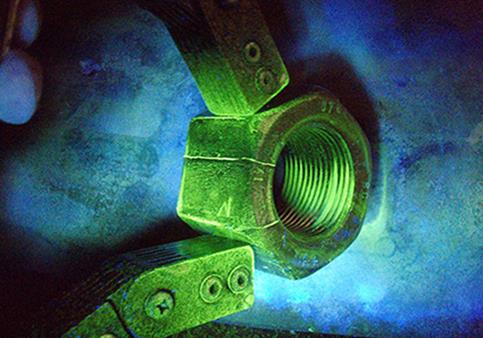
- Photographs - When a photographic record is made, the resulting photograph of the tested surface should, if possible, be actual size. If the surface of the workpiece is highly polished, care should be taken to avoid highlights. The use of a matt-contrast medium applied prior to testing may be desirable.
-
Clear sticky tape - If dry powder is used, no preparation is necessary. If any oil based carrier fluid is used, the surface should be drained and adequately dried. Another possibility is to retest the workpiece using a magnetic ink made with a volatile carrier fluid. The sticky tape is then used to peel the dried magnetic particle indication from the test piece.
a. Cover the indications with a transparent adhesive film. Carefully peel off the film and the adhering indications and reapply to either paper or card of contrasting colour.
b. Degrease the test surface, cover with a white matt adhesive film and retest. After drying, if necessary, cover the indications with a clear film in the manner described in (a) and transfer together the pair of films to the record card.
-
Proprietary coatings sprayed on wet; when dry, the resultant film is then peeled away with the indication.
a. Spray the tested area with a quick-drying, strippable coating. Strip off this coating and view the face previously in contact with the workpiece, to which the indications will be transferred.
b. Heat the workpiece to an approved temperature and, without delay, slowly immerse in a powdered plastic material and slowly withdraw. Allow it to drain and cure it in accordance with the manufacturers instructions. Strip off the coating complete with indications from the workpiece and view the face previously in contact with it.
c. Degrease the test surface and coat with a proprietary, strippable, magnetic oxide paint. Magnetise the part to saturation and peel off the coating. If it is dipped in agitated magnetic ink, it will reveal the flaw indications on the oxide film.
d. Degrease the test area and coat with a proprietary self curing magnetic silicone- rubber compound. Magnetise to saturation and allow the compound to cure. The oxide in the compound will migrate to the position of any flaw and, when removed from the workpiece, the rubber previously in contact with the surface will show the flaw. This may be viewed under magnification if required. This system is often utilized when checking internal screw threads.
-
Magnetic sachets with light sensitive paper backings.
-
Magneto-graph.
BS EN ISO 17638 also lists:
- Transparent varnish for ‘freezing’ indications on the test surface.
- Video recording.
- Epoxy or chemical magnetic particle mixtures.
- Magnetic tapes.
- Electronic scanning.
BS EN ISO 9934-1 does not list preservation techniques, but it states
indications should be recorded as linear or rounded, i.e.
- Linear – the length is more than three times the width.
- Rounded – the length is equal to or less than three times the width.
Limitations of preservation methods
Methods 1 and 2 above are generally restricted to surfaces of simple geometric form because of the difficulties involved in removing the films.
Method 3b does not generally produce satisfactory results from fluorescent magnetic inks as compared with black magnetic inks.
Method 3d is popular for inspecting difficult areas of access such as blind holes and/or coated objects where the prolonged magnetising cycle (approximately 15 to 20 minutes for the carrier material to solidify) increases sensitivity to the flaws weaker leakage field through the coating.